

Best Melody Loops for Beginners: Where to Start in 2026
The best melody loops for beginners aren't just easy to find—they're easy to build around. Here's how to pick loops that actually fit your track, where to source them without endless scrolling, and how to process them until they sound like yours.

Get Co-Producer and Arcade with unlimited access to premium, royalty-free samples and instruments. Plus, unlock Portal, Thermal, and Movement.
Try it freeBest Melody Loops for Beginners: Where to Start in 2026
Melody loops can jumpstart a track or derail it, depending on whether you pick the right one and know how to shape it. This covers what makes a loop beginner-friendly, where to find quality content without wasting hours, and how to process loops until they sound like yours.
What makes a melody loop beginner-friendly
A beginner-friendly melody loop has a clear tonal center, simple phrase structure, and clean edits at the loop boundary. These qualities let you build chords and bass around the loop without guessing the key or fighting awkward timing.
Here's what to listen for when auditioning melody loops:
- Clear root note: The loop should land on an obvious tonal center so you can write parts around it without confusion.
- Simple phrase structure: Four or eight bars with a logical start and end point work best. Avoid loops that feel cut mid-phrase.
- Clean edits: No transient clicks, pops, or awkward fades at the loop boundary. A bad edit will haunt you every time the loop cycles.
- Headroom for layering: The loop shouldn't be slammed with compression. You need space to add your own processing.
- Genre-appropriate BPM range: A loop labeled with tempo makes time-stretching less destructive.
Loops that check these boxes save you from corrective work later. You spend less time fixing problems and more time building the track.
Best melody loops for beginners by use case
Not all melody loops serve the same purpose. The right loop depends on what you're building around it.
For vocal-forward tracks
You want sparse, mid-range melodies that leave room for a top-line. Loops with too much harmonic density compete with vocals and create mud.
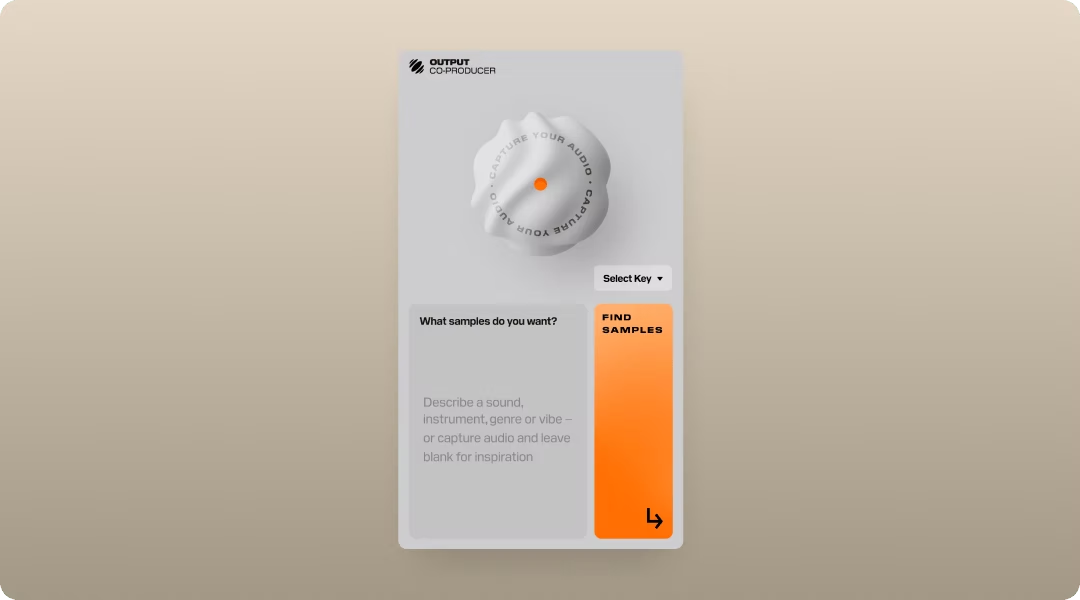
Co-Producer can surface samples that fit your existing session by analyzing what's already playing. You're not guessing which loops will work because the plugin listens to your track and recommends content that matches your key, tempo, and groove. Co-Producer offers three search modes: audio-only (where it analyzes your track), text-only (using descriptive keywords), or a combination of both for the most targeted results.
- Session-aware recommendations: Co-Producer analyzes your track and suggests loops that fit harmonically and rhythmically.
- Drag-and-drop workflow: Preview loops in context, then drag directly into your DAW without leaving the session.
- Unlimited access: No credits or rationing. Explore freely without worrying about download limits.
For cinematic or ambient beds
Pad-heavy, slow-attack loops work well here. Look for cinematic loops with long sustains and gradual movement.
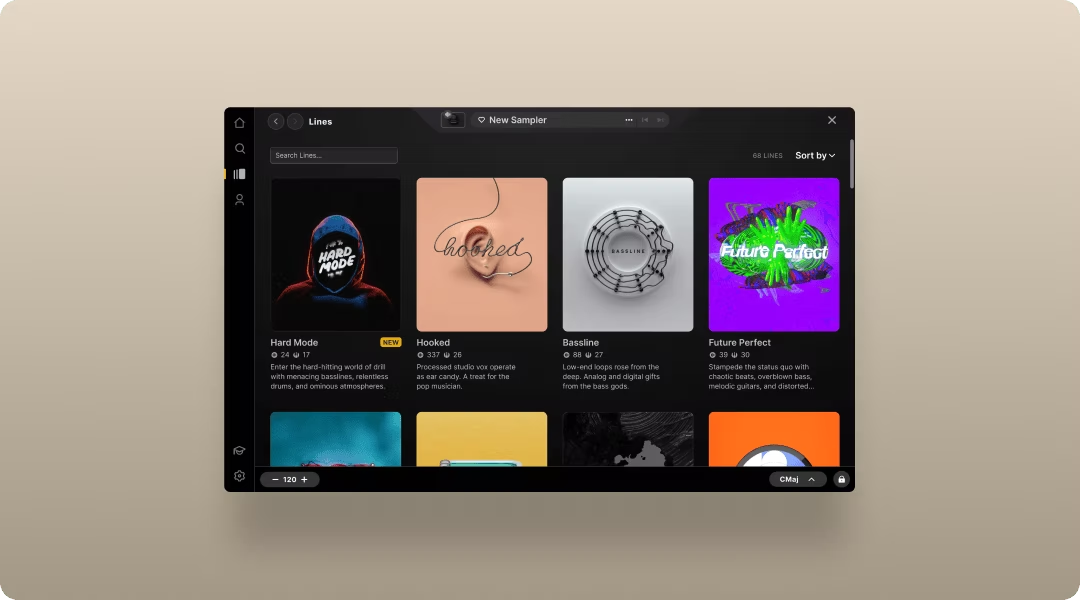
Arcade's Lines are built for this kind of open-ended exploration. You can manipulate ambient textures in real time, adjusting playback speed, direction, and FX without bouncing to audio first. Learn more about how Lines, Kits, and Samples work.
- Playable sampler workflow: Load loops and play them like instruments, not just static files.
- Real-time manipulation: Adjust key, tempo, and FX on the fly while the loop plays.
- Macro controls: Shape the sound quickly with assignable knobs that control multiple parameters at once.
For rhythmic, chop-friendly phrases
Loops with clear transients slice well and respond to chopping without losing their groove. Splice and Loopcloud both offer deep catalogs of rhythmic melodic content.
Splice gives you credit-based access to millions of samples with detailed key and BPM tagging. Loopcloud lets you preview loops synced to your DAW tempo before downloading. For a deeper breakdown, see our Splice vs Loopcloud comparison.
- Splice: Massive catalog, credit-based system, strong genre coverage across electronic, hip-hop, and pop.
- Loopcloud: DAW-synced previews, subscription tiers, and a built-in sampler for quick manipulation.
For lo-fi and textured vibes
Loops with built-in saturation, tape hiss, or vinyl crackle can anchor a lo-fi track without extra processing. Arcade has dedicated lo-fi content that's already treated, so you can drop it in and move on.
BandLab also offers free melody loops with lo-fi character. The quality varies, but the price is right for experimentation. For curated options, explore chill samples in Co-Producer.
Where to find free melody loops without wasting hours
The fastest way to find loops that fit is to let your session do the searching. Co-Producer listens to your track and recommends samples that match your key, tempo, and groove. No keyword digging, no tempo math, no endless scrolling.
Beyond that, here's where to look:
- Subscription-based libraries (Output, Splice, Loopcloud): Unlimited or credit-based access, royalty-free, usually well-organized by key and BPM.
- Free packs from plugin companies: Cymatics, BandLab, and others offer starter packs. Check license terms before releasing anything commercially.
- DAW stock content:Logic, Ableton, and FL Studio ship with usable loops. Good for learning workflow before investing in external libraries.
Avoid packs with no key or tempo info, unclear licensing, or loops that click at the seam. These will cost you more time than they save.
How to use a melody loop in your DAW
Getting a loop into your session is straightforward. A few steps make the process faster and cleaner.
1. Set your session tempo and key first
This makes auditioning loops faster and reduces artifacts from heavy stretching. If you're working at 140 BPM, loops close to that tempo will sound better than loops stretched from 90. If you're using Arcade, here's how to change your Session Key to match your project.
2. Audition in context
Co-Producer lets you preview loops synced to your session's key and tempo before committing. You hear how the loop sits with your existing parts, not in isolation.
3. Drag and drop to an audio track
Most DAWs auto-warp or time-stretch to match tempo. If your DAW doesn't, enable warp mode or flex time before dragging.
Tip for live triggering: If you're playing loops via MIDI rather than dragging to the timeline, Arcade's Input Quantize feature ensures samples start on the beat even if your timing is slightly off. Set it to 1/4 or 1/8 note for forgiving playback.
4. Adjust pitch if needed
Transpose in semitones to fit your chord progression. Watch for formant weirdness on melodic content, especially anything with vocal or acoustic character. Arcade's Playable Pitch feature lets you retune loops in real-time while they play—useful for matching chord changes without bouncing to audio first. Play keys in the lower octaves to shift the pitch of any active sample up or down.
5. Trim and crossfade
Clean up loop points and add short crossfades to avoid clicks. Even well-edited loops sometimes need a few milliseconds of fade at the boundary.
Should you use melody loops or make your own
Loops are a valid starting point, not a shortcut. The question is when they serve the track and when they hold it back.
- Use loops when: You need to move fast, you're learning arrangement, or you want a reference point to build around.
- Make your own when: You want full ownership, you're chasing a specific sound no loop delivers, or you're building a signature style.
- The middle ground:Chop, resample, and process loops until they're unrecognizable. The loop becomes raw material, not the finished part.
Arcade's modifiers and FX let you reshape loops into something new. You can slice, re-sequence, and add effects without leaving the plugin. The original loop is just a starting point.
Tools that make melody loops easier to search, play, and shape
The right tools cut the time between finding a loop and finishing a part.
Sample discovery
Co-Producer listens to your session and recommends loops that fit. It's the fastest path from idea to usable material because you're not searching by keyword. You're letting the plugin analyze your track and surface content that works.
Playable sampling
Arcade turns loops into playable instruments. You can chop, re-sequence, and add FX without leaving the plugin. You're not just dragging files; you're performing and shaping them.
Both Co-Producer and Arcade are available together in Output One, along with Portal, Thermal, and Movement.
FX for shaping loops
Portal adds granular textures to any audio input. Thermal adds saturation and warmth. Movement adds rhythmic motion through tempo-synced modulation.
- Portal:Granular processing that slices audio into tiny grains you can stretch, reverse, pitch-shift, and delay. The SCALE parameter quantizes pitch changes to musical intervals, so random grain modulation stays harmonically coherent with your track.
- Thermal: Multi-stage distortion with 15+ distortion types across three independent stages. Each stage can target a specific frequency range using band-split controls, so you can add grit to the mids while keeping the low end clean—useful for processing loops without muddying the mix.
- Movement: Rhythmic FX engine with LFOs, step sequencers, and sidechain modulation.
Third-party options
Serato Sample is built for chopping and time-stretching. XLN XO helps you organize and manipulate drum loops. iZotope RX cleans up noisy loops with spectral editing.
- Serato Sample: Pitch and time-stretch algorithms, pad-based chopping, key and BPM detection.
- XLN XO: AI-powered drum organization, one-shot extraction, pattern sequencing.
- iZotope RX: Spectral repair, noise reduction, click removal for cleaning up problematic loops.
How to make melody loops sound original
A stock loop sounds like a demo. A processed loop sounds like your track.
Chop and rearrange
Slice the loop into smaller pieces and reorder them. Even simple rearrangements change the feel. Arcade's modifiers make this fast with Playhead, Repeater, and Resequence options. Arcade's Sampler Generator can automatically slice any imported loop across the keyboard, letting you play individual chops as a playable instrument. Choose from different slice modes—including transient detection—to find the chopping style that fits your material.
Add a counter melody
Layer a simple synth or vocal line that responds to the loop's phrasing. Call-and-response creates movement and makes the loop feel like part of a larger composition. String samples work well for this too.
Use AI-powered variations
Co-Producer's Re-Imagine feature generates unique variations of samples using ethically trained AI. Each output is one-of-a-kind and royalty-free, giving you a fresh starting point that's already distinct from the original.
Process with FX
Run the loop through Portal for granular texture, Thermal for saturation, or Movement for rhythmic animation. Each pass adds character and distance from the original.
Resample and print
Bounce the processed loop to audio, then chop it again. Each generation adds distance from the source material.
Automate movement
Automate filter sweeps, panning, or FX wet/dry to keep the loop evolving across the arrangement. Static loops get boring fast.
Common mistakes beginners make with melody loops
These pitfalls trip up new producers more than anything else.
- Stretching too far: Extreme time-stretch creates artifacts. Choose loops close to your session tempo or pitch-shift instead.
- Ignoring key clashes: Dropping a loop without checking the key creates mud. Always verify the loop's root note against your chords and bass.
- No variation across the arrangement: Looping the same eight bars for three minutes sounds like a demo. Chop, mute, filter, or swap loops between sections.
- Skipping license checks: "Free" doesn't always mean "royalty-free." Read the terms before releasing.
- Over-processing: Stacking reverb, delay, and saturation on an already-processed loop buries it. Start with clean loops when possible.
Licensing 101 for melody loops
The difference between "free" and "royalty-free" matters when you release music.
- Free (with attribution): You can use the loop, but you must credit the creator.
- Free (no commercial use): Fine for demos and practice, but you can't release or monetize.
- Royalty-free: You pay once (or access via subscription), then use without ongoing fees or credits.
- Exclusive vs non-exclusive: Some libraries sell exclusive rights. Most are non-exclusive, so the same loop may appear in other tracks.
All loops in Co-Producer and Arcade are royalty-free and cleared for release.
Start with melody loops that fit your track
The fastest path from idea to finished track is using tools that surface the right sounds without endless browsing. Co-Producer listens to your session and finds loops that fit. Arcade lets you play and reshape them. Portal, Thermal, and Movement push them into new territory.
All five are available together in Output One.
FAQ
What is a loop in music production?
A loop is a repeating section of audio, usually two to eight bars, designed to cycle seamlessly. Loops can be melodic, rhythmic, or textural.
Can I release a song made with royalty-free loops?
Yes, if the loops are royalty-free or you've cleared the license. Always check the terms before distributing.
How do I find the key of an unlabeled melody loop?
Most professional libraries label key and BPM in the filename or metadata. If unlabeled, use a tuner or your DAW's pitch analysis to find the root note.
Do melody loops work across different genres?
Yes, but context matters. A lo-fi piano loop won't fit a hard trap beat without processing. Choose loops that match your genre's tonal palette, or process them until they do.
Output One brings together Co-Producer, Arcade, Portal, Thermal, and Movement (plus everything else in the bundle) so you can find loops, flip them into your own melodies, and finish tracks without piecing together separate tools. Try the full workflow in one subscription—free.
Try it free